

WAREHOUSE & SHOWROOM

15700 Middlebelt Rd
(Between 5 & 6 Mile)
Livonia, MI 48154

(734) 751-4413

HOURS

Now open earlier!
Sunday: 11:00 am – 5:00 pm
Monday: 11:00 am – 6:00 pm
Tuesday: CLOSED
Wednesday: CLOSED
Thursday: 11:00 am – 6:00 pm
Friday: 11:00 am – 6:00 pm
Saturday: 10:00 am – 6:00 pm

10 UVC Sterilization Tips for Safer Buying?

Buying Uvc Sterilization equipment can feel like choosing between identical white boxes. The labels often promise “99.9% protection,” yet the real performance may remain unclear. A safer decision requires more than checking wavelength or lamp power.

The International Ultraviolet Association explains that germicidal performance depends on delivered dose, which combines irradiance and exposure time. Distance, shadows, surface texture, airflow, and lamp aging can reduce that dose. ASHRAE’s 2023 Handbook also emphasizes installation design, maintenance, and verified ultraviolet output for effective UVGI systems. A stronger lamp is not automatically a safer or better product.

Safety deserves equal attention. The U.S. Food and Drug Administration warns that some consumer UVC devices can injure skin and eyes within seconds. The 2020 CIE Position Statement on UV-C highlights similar concerns, especially for unshielded devices and poorly controlled exposure. Look for independent test reports, wavelength evidence, shielding, interlocks, timers, ozone information, and clear maintenance instructions. Certification marks should be verified, not simply trusted.

Real buying decisions are rarely perfect. A product may perform well in laboratory conditions but fail around a dusty bathroom corner. That gap matters. These ten practical tips examine what sellers often omit, helping buyers compare evidence, safety controls, and everyday usability before paying. UVC is useful, but it is not magic.
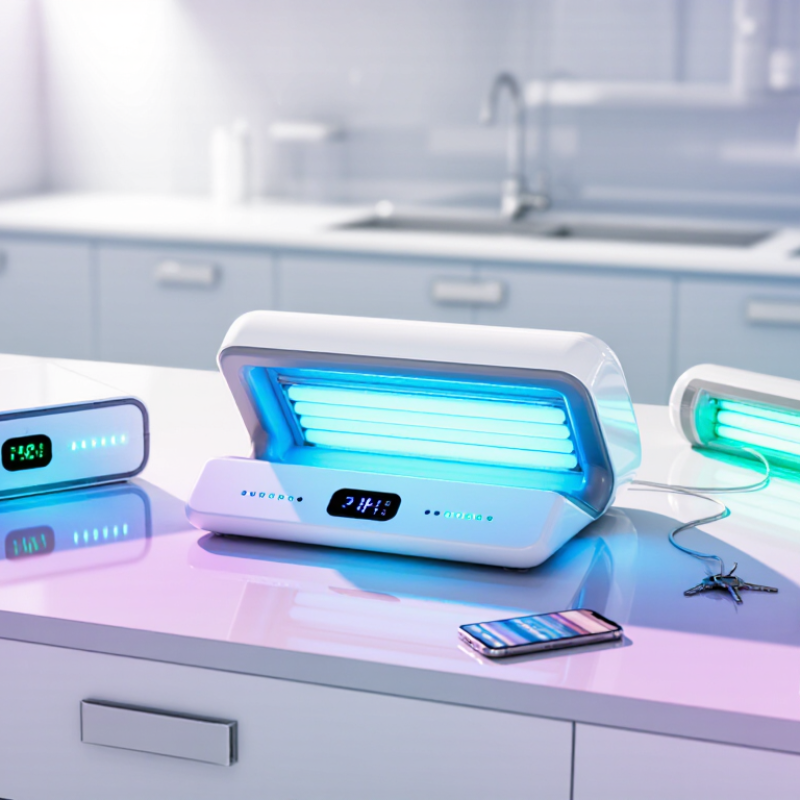
10 UVC Sterilization Tips for Safer Buying?

UVC Basics: 200–280 nm Wavelengths and Germicidal Performance

10 UVC Sterilization Tips for Safer Buying

UVC refers to ultraviolet light between 200 and 280 nanometers. This range can damage microbial DNA and RNA, limiting replication. The germicidal response is often strongest near 265–270 nm, close to nucleic-acid absorption peaks. However, wavelength alone does not prove performance. CIE 155:2003 explains that effectiveness depends on dose, exposure time, and the organism involved. A 254 nm source can work well, but only when the delivered dose is measured accurately.

Check whether test reports identify irradiance, distance, exposure time, and target organisms. The basic calculation is simple: dose equals irradiance multiplied by time.

Real rooms are less simple. Dust, shadows, textured surfaces, and lamp aging reduce exposure. ASHRAE’s 2023 HVAC Applications Handbook describes upper-room UVGI as a supplementary control, not a replacement for ventilation or cleaning.

I would also look for independent laboratory testing and calibrated sensors. Marketing language can hide weak measurements. Some UVC sources below about 240 nm may generate ozone, so ventilation and ozone testing deserve attention.

Direct exposure can injure eyes and skin. That risk is easy to underestimate. A safer purchase includes shielding, interlocks, clear instructions, and documented compliance testing.

Even careful buyers may miss one variable: actual dose at the surface.

Verify Dose: Compare Irradiance and Exposure in mJ/cm²

10 UVC Sterilization Tips for Safer Buying

Verify dose before trusting a UVC product. Irradiance measures power density in mW/cm². Exposure time completes the calculation: irradiance multiplied by seconds equals dose in mJ/cm². For example, 2 mW/cm² for 10 seconds delivers 20 mJ/cm². A bright lamp is not automatically effective. Distance, surface angle, dust, and shadows can sharply reduce the received dose.

Published research shows why dose claims need context. A Scientific Reports study by Biasin and colleagues found approximately 3.7 mJ/cm² achieved a 90% reduction of SARS-CoV-2 under controlled conditions. Higher reductions required substantially more energy. IUVA guidance also stresses that required doses vary by organism, wavelength, humidity, and surface condition. These results are laboratory measurements, not universal promises. Real rooms are messier.

Tips: Ask for measured irradiance at a stated distance, not only lamp wattage. Check whether the figure is radiant output or electrical consumption. Look for a test report identifying wavelength, sensor method, exposure time, and target organism. Measure at the darkest point when possible. A handheld meter can help, but inexpensive meters may be inaccurate. IES RP-44-21 recommends evaluating UV performance, geometry, and safety together. Do not ignore shadows; one unexposed edge can undermine the result. Some product documentation remains vague. Treat that as a buying warning, not proof of failure.

10 UVC Sterilization Tips for Safer Buying: Verify Dose

Calculated exposure time required to deliver a 40 mJ/cm² UVC dose at different irradiance levels.

Dose = irradiance × exposure time. Because 1 mW/cm² equals 1 mJ/cm² per second, a 0.5 mW/cm² reading requires 80 seconds to reach 40 mJ/cm². These are calculation examples, not a universal microbial inactivation claim; actual performance depends on wavelength, distance, shadows, surface reflectivity, and organism.

Check Safety: Apply IEC 62471 Photobiological Risk Limits

When buying a UVC sterilization device, check its photobiological risk report first. IEC 62471:2006 evaluates ultraviolet, visible, and infrared radiation hazards. For conventional 254-nanometer UVC, the actinic ultraviolet exposure limit is 30 J/m² over eight hours. That equals 3 mJ/cm².

Small numbers matter. A device delivering 1 mW/cm² can reach that limit in about three seconds. Never judge safety by lamp wattage alone. Ask for measured irradiance, test distance, wavelength, exposure time, and the laboratory’s accreditation. The ICNIRP ultraviolet guidelines and CIE 239:2020 also support risk assessment through wavelength-weighted exposure, not simple output claims. A timer helps, but it cannot replace shielding, door interlocks, motion detection, and clear warning labels.

Look for testing at realistic distances. A report measured only at the lamp surface may not represent a countertop, cabinet, or room. Reflective metal and glossy plastic can redirect UVC toward hands or eyes. That detail is easy to miss. It should not be.

Check whether the safety system stops emission when a cover opens. Test this function before routine use. Request maintenance guidance, because lamp aging can change output and sensor accuracy. Certification language can sound reassuring, yet vague documents deserve questions. I would prefer a modest, transparent report over impressive claims. Even careful buyers can overlook reflected exposure. That is the part worth reconsidering.

Assess Testing: Require Validated 99.9% Microbial-Reduction Data

A 99.9% microbial-reduction claim sounds reassuring, but the number needs evidence. Ask for a complete laboratory report, not a sales-page sentence. The report should identify the tested microorganisms, exposure time, UV-C wavelength, distance, and surface type. A result from a clean glass plate may not represent a textured object or a crowded room. Testing conditions matter greatly.

Tips: Look for independent laboratory validation and a clear test method. Check whether the 99.9% reduction occurred after one cycle or repeated use. Confirm that the tested device matches the model you plan to buy. Missing details are warning signs. A polished certificate can still leave important questions unanswered.

Safety testing should also explain how the product handles shadows, corners, and uneven coverage. UV-C exposure may be weaker behind an object or under a folded edge. Reliable data should describe these limits instead of implying universal performance. Real-world conditions are messier than laboratory setups. I would also question reports using vague phrases such as “kills germs” without measured results. The percentage may be accurate in one controlled test, yet less meaningful in daily use. Ask for dates, laboratory identification, and repeatability data before trusting the claim.

Buy Responsibly: Confirm Sensors, Shields, Certifications, and Ozone Claims

10 UVC Sterilization Tips for Safer Buying

Buy Responsibly: Confirm Sensors, Shields, Certifications, and Ozone Claims

A UVC device should protect people before it promises cleaner surfaces. Check whether sensors stop the lamp when a lid opens or a person enters the exposure area. Test this feature carefully, without looking at the lamp. A sensor that reacts slowly needs serious reconsideration.

Physical shielding matters just as much. Look for sealed chambers, interlocking covers, and no visible gaps around doors or vents. Reflective interiors can improve coverage, but they may also redirect stray radiation. Place a hand near the housing, not inside it, and inspect for damaged plastic, loose hinges, or exposed openings.

Certification labels deserve close attention. Confirm the certificate belongs to the exact model, not merely a similar product family. Also check what it covers: electrical safety, electromagnetic compatibility, material quality, or germicidal performance. These are different claims. A certificate is useful evidence, not automatic proof of disinfection.

Ozone statements require extra care. Some UVC wavelengths can generate ozone, while others generally do not under normal designs. “Ozone-free” should be supported by test conditions, measurement methods, and limits. Ask whether testing occurred during a full operating cycle. Marketing language can sound precise while remaining incomplete.

Read the manual before buying. It should state exposure limits, cleaning requirements, lamp replacement timing, and safe placement. I have seen promising products with vague instructions. That gap matters. If the seller cannot explain sensor testing or ozone results clearly, choose a product with better documentation.

10 UVC Sterilization Tips for Safer Buying? — Buy Responsibly: Confirm Sensors, Shields, Certifications, and Ozone Claims

No. Buying Tip What to Confirm Why It Matters Responsible Buying Check
1 Verify the UV-C wavelength Look for a stated wavelength within the germicidal UV-C range of approximately 200–280 nm, rather than a vague “UV light” claim. UV effectiveness depends strongly on wavelength, optical output, exposure time, and the target microorganism. Prefer products with a wavelength specification and supporting test documentation.
2 Ask for irradiance and dose data Check whether the supplier reports irradiance, usually in microwatts per square centimeter, and exposure dose, usually in millijoules per square centimeter. Power consumption alone does not show how much UV-C energy reaches the surface being treated. Choose products with measurement conditions, distance, exposure time, and test method clearly stated.
3 Confirm automatic safety sensors For open or portable units, verify motion, door, lid, or tilt sensors that interrupt UV-C emission when people or animals could be exposed. Direct UV-C exposure can injure eyes and skin, even when exposure is brief. Do not rely on a sensor description alone; look for functional testing and clear operating instructions.
4 Check shielding and interlocks Inspect whether the design prevents line-of-sight exposure and whether doors, covers, or access panels have reliable interlocks. Physical shielding reduces the chance that UV-C escapes during operation or that a unit runs while open. Prefer enclosed systems for homes, workplaces, and shared environments.
5 Review ozone claims carefully Determine whether the product generates ozone, whether it uses a wavelength below about 240 nm, and whether ozone-emission test results are available. Some UV sources can generate ozone, while many UV-C LEDs and low-pressure lamps designed for germicidal use are marketed as ozone-free. The claim must be verified for the specific model. Avoid vague “no ozone” wording without a test method, limit, or operating condition.
6 Look for independent safety certification Check for certification or conformity documentation relevant to the sales region, electrical safety, photobiological safety, and electromagnetic compatibility. Certification can indicate that the product has been assessed against recognized safety requirements, although it does not prove disinfection performance by itself. Verify certificate numbers and scope through the issuing organization where possible.
7 Separate disinfection evidence from marketing Request laboratory reports identifying the organism, surface or air setup, UV dose, distance, humidity, exposure time, and reduction achieved. Results for one microorganism or test surface cannot automatically be applied to every virus, bacterium, mold, object, or room. Give greater weight to transparent, reproducible test conditions than to broad “99.9%” claims.
8 Consider shadows and surface coverage Check whether the target must be rotated, whether objects need spacing, and whether dirt, dust, folds, or opaque materials can block the light. UV-C works only where sufficient light reaches the surface; shadows and contamination can reduce effectiveness. Choose a design and workflow that expose all relevant surfaces without manual shortcuts.
9 Check maintenance and lamp aging Review cleaning requirements, expected operating life, replacement indicators, and how output changes over time. Dust, residue, and aging lamps or LEDs can reduce UV-C output even when the device still appears to operate normally. Prefer products that provide an output check, service guidance, or replacement schedule.
10 Use UV-C as a supplement, not a substitute Confirm that the instructions also address ordinary cleaning, ventilation, hand hygiene, and safe handling of treated items. UV-C does not remove dirt and may not reach every contaminated area. Effective risk reduction usually requires multiple controls. Do not use UV-C devices as a replacement for approved cleaning and infection-control procedures.
Safety note: Never look directly at an operating UV-C source or expose skin to it. Follow the manufacturer’s instructions, keep people and animals away from open units, and ventilate the area if ozone generation is possible.