

WAREHOUSE & SHOWROOM

15700 Middlebelt Rd
(Between 5 & 6 Mile)
Livonia, MI 48154

(734) 751-4413

HOURS

Now open earlier!
Sunday: 11:00 am – 5:00 pm
Monday: 11:00 am – 6:00 pm
Tuesday: CLOSED
Wednesday: CLOSED
Thursday: 11:00 am – 6:00 pm
Friday: 11:00 am – 6:00 pm
Saturday: 10:00 am – 6:00 pm

China Top Bar Height Tables Manufacturers for Global Buyers

Bar-height seating gives cafés, hotel lounges, and restaurant counters a clear visual rhythm. It also affects comfort, circulation, and how efficiently a compact floor plan works. For global buyers, choosing Bar Height Tables is therefore more than a styling decision. Table height, base stability, surface durability, and packaging all matter once products reach busy commercial spaces.

Demand across hospitality provides useful context. UN Tourism’s World Tourism Barometer reported about 1.4 billion international tourist arrivals in 2024, roughly 99% of the 2019 level. The National Restaurant Association’s 2024 State of the Restaurant Industry projected U.S. restaurant sales of $1.1 trillion that year. These figures do not measure bar-table sales directly. Still, they show why hospitality operators need furniture that can handle frequent use and changing guest volumes. That distinction matters.

China’s manufacturing base offers buyers a wide range of materials, finishes, and production options. Yet a polished catalogue image cannot confirm real-world performance. Buyers should request dimensional drawings, finish samples, stability details, packaging specifications, and clear production timelines. Ask how a supplier checks tabletop consistency and protects edges during shipment. Where possible, inspect a sample or arrange an independent factory review. Small details count. A few suppliers may look similar online, but their communication and quality controls can differ. This guide introduces China’s top Bar Height Tables manufacturers for global buyers, while keeping the selection criteria practical, verifiable, and focused on the needs of commercial projects.
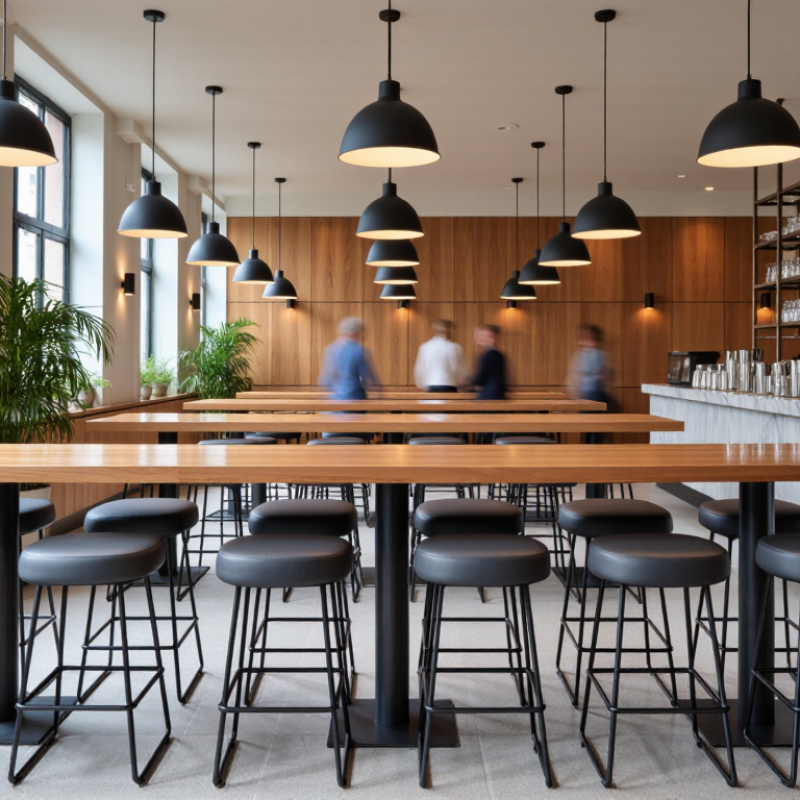
China Top Bar Height Tables Manufacturers for Global Buyers

Understanding Bar-Height Tables and Their Common Uses

Bar-height tables usually stand about 40 to 42 inches tall, though dimensions can vary by design and market. They pair best with stools whose seats measure roughly 28 to 30 inches high, leaving comfortable space for knees. Always check both measurements before ordering. A few inches matter.

These tables suit cafés, casual dining areas, kitchen islands, and event spaces where people gather briefly or prefer an elevated seat. A narrow rectangular top can fit along a wall, while a round table encourages conversation in a smaller corner. In busy venues, sturdy bases and easy-to-clean surfaces help with daily use; sharp edges and unstable feet can become annoyances. For shared work areas, the height supports quick discussions, but it may not suit long sessions for every user.

Room layout deserves equal attention. Allow enough clearance for stools to slide out, and consider how guests move between tables. Bar-height furniture can make a room feel open, yet it is not ideal for every customer or activity. I have seen buyers focus on appearance and overlook seat comfort. That is an easy mistake to make.

China’s Bar-Height Table Manufacturing Landscape

China’s bar-height table manufacturing landscape spans export-focused factories, specialist workshops, and suppliers serving hospitality and residential projects. Common designs pair steel or aluminum frames with solid wood, engineered panels, or compact laminate tops. Production capabilities vary: some facilities handle cutting, welding, coating, and assembly in-house, while others coordinate several specialist partners. Buyers should confirm which processes are controlled directly.

Small details matter. A factory assessment should look beyond polished showroom samples. Check weld consistency, coating coverage around joints, tabletop edge finishing, and how firmly the frame stands on an uneven floor. Ask for dimensional drawings, material specifications, and inspection records. These make comparisons more reliable than photos alone. Manufacturing quality is not uniform across the market; smaller workshops may rely on manual finishing, so color or surface texture can vary between batches.

For custom orders, clear specifications help prevent avoidable changes. State the required table height, base dimensions, load expectations, finish, packaging method, and acceptable tolerances. Request a production sample when the order involves a new structure or surface treatment. Samples can reveal practical issues, such as a footrest placed too high for comfortable use. Lead times and export packing also depend on order size, component availability, and shipping arrangements, so buyers should verify these details before approving production.

China Top Bar Height Tables Manufacturers for Global Buyers - China’s Bar-Height Table Manufacturing Landscape
Buyer Dimension Common Options or Reference Range What to Confirm with a Manufacturer
Table height Counter-height tables are commonly about 34–36 in (86–91 cm); bar-height tables are commonly about 40–42 in (102–107 cm). Specify finished floor-to-tabletop height and confirm whether adjustable feet are included.
Seating compatibility A typical starting point is a seat height around 24–26 in (61–66 cm) for counter-height tables and 28–30 in (71–76 cm) for bar-height tables. Check the actual chair or stool seat height and allow comfortable clearance between the seat and tabletop.
Tabletop materials Common choices include solid wood, wood-based panels with laminate or veneer, metal, and stone or stone-look surfaces. Ask for material specifications, edge treatment, finish samples, and cleaning or maintenance guidance.
Base and frame Bases may use steel, stainless steel, aluminum, wood, or combinations of materials; common forms include pedestal and four-leg designs. Confirm base dimensions, stability, floor-protection features, and suitability for the intended indoor or outdoor setting.
Shape and footprint Square, rectangular, and round tops are widely used; size depends on seating capacity, circulation space, and installation layout. Provide a dimensioned drawing and confirm the top overhang, base position, and required space for chairs or stools.
Finish and color Possible finishes include painted or powder-coated metal, clear or stained wood finishes, laminates, and plated metal surfaces. Approve a physical sample or color reference and clarify acceptable variation between production batches.
Customization Depending on the production setup, orders may specify dimensions, materials, finishes, base styles, and packaging requirements. Request a written specification sheet, confirm sample approval, and identify which details affect minimum order quantities or pricing.
Quality checks Useful checks include measurement verification, surface and finish inspection, joint and fastener checks, and stability testing. Agree on inspection criteria, sampling approach, defect definitions, and any required test reports before production.
Export packing Packing may include protective wrapping, corner protection, carton packaging, or palletization, depending on product design and shipment requirements. Confirm packed dimensions and weight, protection for vulnerable surfaces, labeling, and whether assembly hardware is included.

Height figures are common design reference ranges, not universal requirements. Confirm final dimensions and product specifications for each order.

Materials, Designs, and Production Processes

Material selection affects a bar-height table’s stability, appearance, and service life. Many manufacturers combine steel frames with solid wood, engineered wood, or laminate tops. Steel tubing offers a sturdy base, while a sealed wood surface can show natural grain. Check tabletop thickness, edge treatment, and finish consistency. Small details matter. In humid environments, poorly sealed edges may swell, so buyers should request suitable moisture-resistant materials and clear care instructions.

Design begins with the table’s intended setting. A compact square top may suit a café, while a longer rectangular model can serve shared dining areas. Buyers should confirm the table height alongside the seat height, leaving comfortable legroom. Footrests, adjustable glides, and a broad base can improve everyday usability. Yet oversized bases may obstruct chairs. There is no perfect layout for every room.

Production commonly includes material cutting, frame welding, surface preparation, finishing, assembly, and inspection. CNC cutting can support repeatable dimensions, but careful manual checks still matter. Inspect welds, tabletop alignment, and coating coverage before packing. A pre-production sample helps confirm color and proportions. Even then, wood grain varies, and small finish differences can occur. Ask suppliers how they document tolerances, test stability, and protect corners during shipping.

How to Evaluate Chinese Bar-Height Table Manufacturers

How to Evaluate Chinese Bar-Height Table Manufacturers

A polished showroom sample is only a starting point. Ask for dimensioned drawings, material specifications, and recent inspection records for the same table design. Check tabletop thickness, edge finish, weld consistency, and whether the base rocks on a level floor. Ask how the factory tests load capacity and repeated use. Request the test method and results, not just a claim of “heavy duty.” Small details matter.

Review quality controls at each production stage. For metal frames, inspect welds and coating coverage; for wood tops, confirm moisture controls and finish consistency. Compare a pre-production sample with the approved drawings, then document any changes in writing. Ask how defects are recorded and corrected. I sometimes give too much weight to a neat sample; it may not represent a full production run.

Delivery capability deserves separate scrutiny. The World Bank’s 2023 Logistics Performance Index gave China a score of 3.7 and ranked it 19th among 139 economies. This is a national logistics benchmark, not proof of an individual factory’s reliability. Request a realistic production schedule, carton dimensions, packing photos, and shipment records for comparable orders. Check that the supplier can explain how it prevents scratches, loose fittings, and transit damage. A video call helps, but it cannot replace independent inspection.

Global Sourcing, Quality Checks, and Shipping Considerations

China Top Bar Height Tables Manufacturers for Global Buyers

Global sourcing begins with a clear product brief. Specify table height, top dimensions, materials, finish, and intended use. A drawing with measurements can prevent costly misunderstandings. Ask suppliers about minimum order quantities, production lead times, packing methods, and spare parts. Compare quotations carefully; a low unit price may exclude protective packaging or inspection. Details matter.

Quality checks should match the table’s daily demands. Request a pre-production sample when practical, then check its height, stability, edge finish, and welds. Place it on a level floor and test for wobble. Ask for inspection records and clear photos of packed goods. Photos help, but they cannot replace a hands-on check. Minor finish variation can happen, so define acceptable limits before production.

Tips: Confirm carton dimensions and gross weight before booking freight. Ask how corners and tabletop surfaces are protected. For container shipments, leave time for loading and customs handling; schedules do slip. Keep one written checklist for the supplier, inspector, and freight forwarder. It is easy to miss one small detail.