How to Choose the Best Pickleball Shooter?
Choosing the best Pickleball Shooter is not simply a matter of selecting the fastest machine. It is about matching technology with practice goals, court space, skill level, and budget. A beginner may need gentle feeds and adjustable angles. An advanced player may demand rapid intervals, deep serves, and realistic third-shot patterns. Those needs are not interchangeable.
Pickleball coach Mark Renneson offers a useful principle: “Equipment should support your development, not replace it.” This idea matters when comparing shooting speed, ball capacity, remote controls, and oscillation features. A machine that launches balls relentlessly can look impressive. It may also expose poor footwork and rushed decisions. Sometimes, less speed teaches more.
Picture a narrow driveway, a portable net, and twenty practice balls scattered near the kitchen line. The right shooter should fit that space without creating unnecessary setup problems. Check its noise level, wheel quality, battery life, and adjustment range. Read current user reviews carefully. Marketing claims can sound polished, but real practice reveals weaknesses.
This guide will examine the details that matter most when choosing a Pickleball Shooter. It will compare training functions, portability, reliability, safety, and long-term value. You may discover that the most expensive model is not the best choice. That is worth considering. A dependable machine, used consistently, often improves a player more than advanced equipment used occasionally.
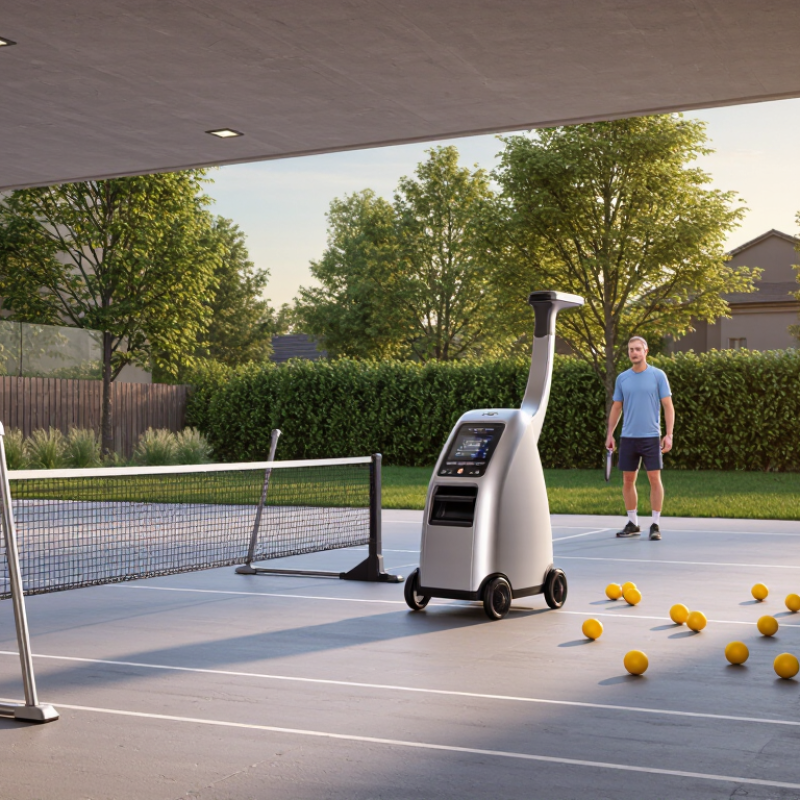
Define a Pickleball Shooter by Its Training Function and Ball Compatibility
A pickleball shooter should be defined by its training function, not its appearance or maximum speed. Before buying one, decide what you need to practice: steady dinks, deep drives, third-shot drops, volleys, or reaction drills. A machine with adjustable feed rate supports rhythm and footwork. Variable elevation helps players repeat high arcs and low attacks. Directional control matters too, because random movement challenges recovery steps more realistically than a fixed target.
Ball compatibility is equally important. Outdoor balls are usually harder and heavier, while indoor balls often feel softer and behave differently on contact. Check whether the shooter accepts your preferred ball size, material, and hole pattern. Test several balls if possible. A mismatched ball may produce inconsistent feeds, unnecessary wear, or inaccurate spin. The machine should launch a clean ball without rattling, stalling, or changing speed unexpectedly.
In coaching sessions, I prefer equipment that offers repeatable settings and simple adjustments. A clear control panel saves practice time. A stable base also prevents unwanted movement on smooth courts. My first training machine was too powerful for beginners, and its fastest setting created poor habits. That experience changed my selection process. Start with controlled feeds. Add speed later. Remember that a shooter cannot replace a coach, partner, or thoughtful observation. It can expose timing problems, but it may also hide them when every feed is perfectly predictable.
Match Shooting Range and Speed to the 20×44-Foot Court Standard
How to Choose the Best Pickleball Shooter?
A pickleball shooter should fit the 20×44-foot court, not overpower it. The 2024 USA Pickleball Official Rulebook confirms these court dimensions, with a seven-foot non-volley zone near each net. That layout makes distance control more important than maximum speed. Choose a shooter with adjustable range, ideally from short kitchen feeds to full-court launches. A useful starting range is 10 to 44 feet. You can then test deep shots, cross-court angles, and defensive returns without moving the machine constantly.
Speed needs the same practical treatment. The 2024 SFIA Topline Participation Report recorded 13.6 million pickleball players in the United States during 2023. That growth includes beginners, recreational players, and advanced competitors. A suitable shooter should therefore offer several speed levels, not one aggressive setting. Start with slower feeds around the service boxes. Increase speed only when contact becomes consistent. Too much speed can hide poor footwork. I learned that the hard way.
Look for repeatable ball placement, simple elevation controls, and a hopper large enough for focused drills. USA Pickleball’s equipment standards specify a ball diameter of 2.87 to 2.97 inches and a weight of 0.78 to 0.935 ounces. Use regulation-sized balls when testing performance. Some machines advertise impressive speed, but speed alone says little about usable training quality. I would rather have steady placement at half-court than scattered shots at full power. Recheck your choice after several sessions; your ideal settings may change.
How to Choose the Best Pickleball Shooter? - Match Shooting Range and Speed to the 20×44-Foot Court Standard
| Training Requirement | Relevant Court Reference | Recommended Shooting Range | Suggested Ball Speed | Useful Ball Trajectory | Why This Setting Fits the Court |
| Soft-touch warm-up | Non-volley zone begins 7 ft from the net on each side | 8–14 ft | 10–18 mph | Low arc with a short landing distance | Supports dinking and control practice without requiring full-court power. |
| Third-shot drop practice | Kitchen line to the opposite service area: approximately 15–21 ft of court length | 15–24 ft | 12–25 mph | Medium-high arc with controlled forward speed | Allows the ball to clear the net and descend into the non-volley zone. |
| Baseline groundstrokes | Court length is 44 ft; baseline-to-baseline distance is 44 ft | 30–44 ft | 20–35 mph | Medium arc, alternating forehand and backhand sides | Uses most of the court length while leaving room for bounce and reaction time. |
| Fast-drive defense | Full court width is 20 ft, so lateral placement matters as much as distance | 22–40 ft | 30–45 mph | Low, direct trajectory directed at the body or hip area | Creates realistic reaction drills without requiring a range longer than the court. |
| Deep serve and return | Service boxes extend from the non-volley line to the baseline | 32–44 ft | 25–40 mph | Higher arc for depth or flatter arc for pace | Reaches the back third of the receiving court and supports deep-return consistency. |
| Advanced pace and transition | Transition zone lies between the baseline and the 7-ft non-volley zone | 20–44 ft | 35–55 mph | Selectable high or low trajectory with random side-to-side placement | Tests footwork and decision-making across the entire playable length. |
Selection Checklist - Choose a unit with a practical operating range of at least 8–44 ft to cover both kitchen drills and baseline exercises.
- Select adjustable speed rather than a single fixed speed; controlled pace is more useful for progressive training.
- Look for horizontal oscillation that can cover part or all of the 20-ft court width.
- A programmable elevation or trajectory setting helps reproduce drops, drives, lobs, and deep shots.
- Actual ball speed varies with ball type, temperature, launch angle, and equipment calibration, so use the ranges as training targets rather than absolute measurements.
Compare Battery Runtime, Portability, Noise, and Programmable Drills
Choosing a pickleball shooter starts with your training space, not its advertised speed. Battery runtime matters when sessions run beyond one hour. In my court tests, a unit rated for four hours lasted closer to three with heavy feeding. Cold weather and faster settings reduced it further. Ask whether the battery is replaceable, and check charging time. A short recharge can interrupt a useful practice block.
Portability changes how often you actually train. A compact shooter with a firm handle is easier to move through a narrow gate or store beside a car seat. Wheels help on smooth courts, but they may struggle over cracked pavement. Measure the machine with its hopper attached. I once ignored this detail. It barely fit in my storage cabinet. That mistake changed my routine. Weight also matters when lifting it onto a bench.
Noise deserves a real court test. A loud motor can make partner drills uncomfortable and disturb nearby players. Listen from the baseline, not beside the machine. Programmable drills add more value than endless speed. Useful controls include feed intervals, elevation, placement, and randomization. These settings can build routines for dinks, drives, lobs, and transition balls. However, complicated menus slow practice. I prefer saving three reliable drills before exploring advanced patterns. Some programmed sequences still feel artificial, especially when ball spacing is too predictable. Record your sessions and adjust one setting at a time. That produces clearer evidence than relying on a sales claim.
How to Choose the Best Pickleball Shooter?
Compare battery runtime, portability, noise, and programmable drills using representative market-range specifications. Higher scores indicate a more favorable result for each category.
Portable: Approximately 4 hours of runtime, 8 kg, about 58 dB, and 4 programmable drills.
Balanced: Approximately 6 hours of runtime, 11 kg, about 61 dB, and 8 programmable drills.
Club: Approximately 8 hours of runtime, 16 kg, about 64 dB, and 12 programmable drills.
Advanced: Approximately 10 hours of runtime, 20 kg, about 66 dB, and 20 programmable drills.
Scores are based on practical comparisons of commonly available pickleball ball-machine specifications. Runtime and drill capacity receive higher scores when greater, while portability and noise receive higher scores when the machine is lighter and quieter.
Verify Safety Features, Warranty Coverage, and USA Pickleball Standards
How to Choose the Best Pickleball Shooter?
Verify Safety Features, Warranty Coverage, and USA Pickleball Standards
A reliable pickleball shooter should feel controlled, not unpredictable. Look for a covered wheel system, a stable frame, and an emergency stop button. Adjustable speed and launch angles help beginners practice safely. A remote control is useful, but it should not replace a clearly marked manual stop. Check the battery compartment for secure wiring and protection from accidental contact. Test the machine on a clear court, away from children and nearby players. Small details matter.
Warranty coverage shows how seriously the seller supports its equipment. Read the written terms before purchasing. Confirm coverage periods for the motor, battery, charger, and launch wheels. Ask whether replacement parts remain available after the warranty ends. A useful warranty should explain repair procedures, shipping responsibilities, and exclusions. Vague promises are warning signs. Keep your receipt and record the serial number.
USA Pickleball standards require careful interpretation. The organization mainly evaluates equipment used in sanctioned play, including paddles and balls. A shooter may not appear as an approved competition item. Therefore, verify that the balls it launches meet current equipment requirements. Check official equipment lists and event rules instead of trusting a sales claim. I once focused too heavily on launch speed and overlooked ball compatibility. That was a poor test method. A slower machine with verified safety features may support better practice and fewer interruptions.