

Who Are the Top Foldable Table Manufacturers in China?
Choosing a reliable Foldable Table manufacturer in China takes more than comparing prices or browsing polished product photos. This guide introduces notable suppliers and explains what buyers should examine before requesting a quotation. “Top” can mean different things: a factory may excel at large orders, while another may offer stronger customization or smaller production runs.
Look closely at the details that affect daily use. Check frame materials, hinge construction, tabletop thickness, edge finishing, and how securely each table locks when opened. Ask whether the manufacturer can share inspection records, load-test information, and clear specifications for packaging and delivery. A neat sample is useful, but it does not prove every unit will match.
Details matter.
The companies discussed here should be assessed against your own product requirements, order volume, and communication needs. Confirm manufacturing capabilities directly, and request current documents rather than relying on broad claims about quality or certifications. If possible, inspect a sample and test its stability on an uneven floor. That small step can reveal loose joints or awkward folding mechanisms.
No supplier is perfect, and a strong catalog cannot answer every question. Some details may remain unclear until you ask for evidence. This overview offers a practical starting point—not a substitute for independent checks—so buyers can compare Chinese manufacturers with greater care and choose a partner suited to their market.
What Defines a Foldable Table Manufacturer in China?
A foldable table manufacturer in China is more than a workshop assembling tabletops and legs. It should understand how materials, joint design, and production control affect daily use. Ask what the frame is made from, how its finish is applied, and how the hinges are secured. Clear answers matter.
Look for repeatable quality checks, not just polished product photos. A capable factory can explain how it checks table stability, folding cycles, edge finish, and load performance. Request test records and sample units, then inspect the details yourself. Small details matter. Does the table wobble on a flat floor? Do locking parts engage smoothly? Are exposed edges clean and even?
Manufacturing capability also includes practical communication. The supplier should confirm dimensions, packaging, lead times, and any design changes in writing. A sample may feel solid, while a later batch reveals inconsistent welds or loose fittings; this can happen, so ask how production batches are inspected. No checklist removes every risk. A useful manufacturer is willing to discuss limitations and show how problems are tracked, rather than promising perfection. That openness, supported by observable processes, helps buyers judge whether a supplier can meet their needs.
How China’s Foldable Table Industry Is Structured
China’s foldable table industry is a network of specialized suppliers, not a single type of factory. Some manufacturers cut and bend steel tubing, weld frames, and apply protective finishes in-house. Others focus on assembly, sourcing tabletops and hardware from nearby suppliers. Plastic, wood-based panels, and metal are common material choices, depending on the table’s intended use and price point.
Production is often organized around repeatable steps: frame fabrication, surface finishing, tabletop preparation, assembly, and inspection. A factory may handle several steps itself, while another relies on outside workshops. That difference can affect lead times and make quality checks more complicated. The structure varies.
Export buyers may work directly with a manufacturer or through a trading company that coordinates production and shipping. A product listing alone does not confirm who made the table. Buyers can ask for factory details, material specifications, load-test procedures, and inspection records. These questions are practical, but answers still need verification. A clear process matters more than polished sales language. I’d avoid treating “factory” as a guarantee of consistent quality; production control differs, even among suppliers with similar catalogs.
Leading Foldable Table Manufacturers in China
China’s leading foldable table manufacturers are best judged by more than catalog photos. Look for factories that can explain their frame materials, hinge design, surface options, and quality checks in clear terms. A dependable supplier should provide drawings, sample specifications, and realistic production timelines. Ask how workers inspect locking parts and table legs before packing. These details matter when tables will be opened and folded often.
Tips: Request a sample and test it on a flat floor. Check whether the legs lock firmly, the tabletop sits evenly, and the edges feel smooth. Ask for documented load-test results and packaging details. Small checks help. A polished sample, however, does not guarantee every production unit will match it, so agree on inspection criteria before placing an order.
Manufacturers with flexible production lines may offer different sizes, tabletop finishes, frame colors, and carton options. For bulk orders, confirm minimum quantities, lead times, spare-part availability, and how changes are handled after sample approval. Request recent product records or factory quality documents where available. Compare responses, not just prices. Some suppliers communicate well but provide vague test details; that is worth questioning. A little caution saves trouble later.
Common Products and Manufacturing Capabilities
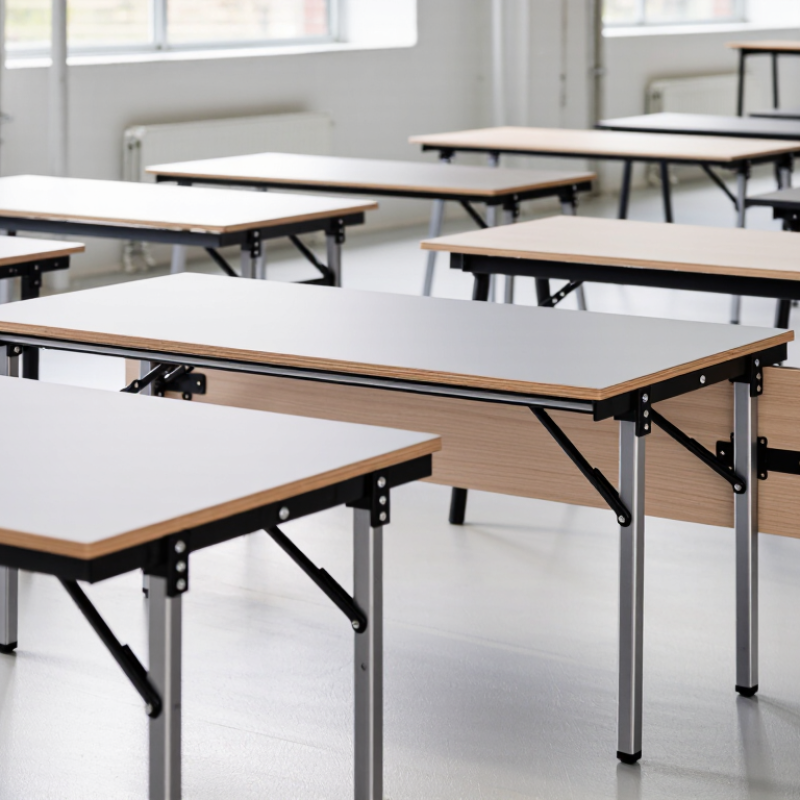
Chinese foldable-table manufacturers commonly produce banquet tables, camping tables, utility tables, and classroom or training tables. Typical designs pair a plastic or laminated tabletop with steel or aluminum legs. Round banquet tops, narrow conference tables, and compact camping models serve different spaces. Small details matter: rounded corners, non-slip feet, and secure leg locks affect everyday use.
Manufacturing capabilities vary by factory. Some facilities handle tabletop forming, tube cutting, welding, coating, and final assembly in-house; others source parts from outside suppliers. Ask how factories check hinge alignment, tabletop flatness, and leg stability. A sample that opens smoothly is useful, but it does not prove every batch will match. Request production photos, material specifications, and documented inspection results. Not every factory does everything.
Tips: Share the table’s intended use, dimensions, target load, and storage needs before requesting a quote. Ask for a sample and inspect its joints, edges, and folding action. A tidy catalog can hide uneven finishing, so leave room for a second review.
Who Are the Top Foldable Table Manufacturers in China? - Common Products and Manufacturing Capabilities
Indicative overview of product types and manufacturing capabilities commonly found in China’s foldable-table industry. Specifications and available processes vary by factory and model.
| Product or Capability | Common Products and Materials | Typical Manufacturing Processes | Common Customization Options | Buyer Checks |
|---|---|---|---|---|
| Plastic folding tables | Portable tables with molded plastic tops and folding metal legs; used for events, homes, schools, and light commercial settings. | Plastic molding, metal-tube cutting and forming, surface finishing, hardware assembly, and final inspection. | Table dimensions, top color, frame finish, edge design, leg-lock style, and packaging. | Ask for material specifications, stability test results, folding-cycle information, and the stated load-test method. |
| Blow-molded HDPE tables | Tables with hollow, blow-molded high-density polyethylene tops and metal support frames; commonly selected for indoor and outdoor use. | HDPE blow molding, frame fabrication, powder coating or other finishing, assembly, and dimensional checks. | Top shape and size, color, frame geometry, carry handle, and carton configuration. | Confirm resin and UV-resistance claims, surface and edge quality, frame corrosion protection, and performance under the intended conditions. |
| Banquet and event tables | Rectangular or round folding tables with plastic, plywood, or laminated tops; commonly supplied in event-oriented sizes such as 4 ft, 6 ft, and 8 ft lengths. | Top-panel forming or machining, edge finishing, steel-frame welding, coating, hinge installation, and assembly. | Length, width, top thickness, surface finish, frame color, folding mechanism, and optional transport accessories. | Check the exact dimensions, table weight, frame bracing, edge durability, stacking or storage requirements, and applicable safety requirements. |
| Camping and portable tables | Compact folding tables, often with aluminum or steel frames and plastic, aluminum, or fabric-based tops. | Tube cutting and forming, lightweight-panel or fabric assembly, joint installation, finishing, and pack-size checks. | Folded dimensions, adjustable height, frame material, tabletop layout, carrying bag, and color. | Verify packed size and weight, locking-joint design, stability on uneven ground, and the supplier’s stated load limits. |
| Frame fabrication and finishing | Steel or aluminum tubular frames, braces, hinges, feet, and locking components used across multiple folding-table designs. | Tube cutting, bending, drilling, welding, deburring, coating, and fixture-based assembly. | Tube dimensions, frame geometry, weld locations, finish color, foot design, and hardware selection. | Request details on material grade, weld inspection, coating process, corrosion testing, and replacement-hardware availability. |
| OEM/ODM and quality control | Private-label production, product adjustments, packaging development, and manufacturing to buyer-provided drawings or specifications. | Sample development, drawing review, production planning, incoming-material checks, in-process inspection, and finished-product inspection. | Dimensions, colors, logos, labels, cartons, manuals, and selected material or hardware changes, subject to feasibility. | Agree on approved samples, inspection criteria, test methods, packaging requirements, lead times, and documentation before production. |
How to Compare Chinese Foldable Table Manufacturers
When comparing Chinese foldable table manufacturers, look beyond the quoted price. Ask for the tabletop material, frame thickness, open dimensions, and folded dimensions. A steel frame should have even welds and a finish without sharp edges or bare patches. Check how the locking hinges engage; they should hold firmly without excessive force. Small details matter. Request the load rating and ask how it was tested. A clear answer is more useful than a large, unsupported number.
Tips: Request a sample before placing a large order. Open and fold it repeatedly, then check for wobble, pinched fingers, and loose fasteners. Confirm packaging dimensions, production lead time, and how defects are handled in writing.
Compare quotations line by line, including accessories, packaging, inspection, and shipping terms. Ask whether the quoted model matches the sample exactly. If possible, review a recent production run or arrange an independent inspection before shipment. Communication is part of quality: precise replies about tolerances and replacement parts suggest stronger process control. Still, one good sample cannot prove every batch will be consistent. That is easy to overlook, and worth checking again.

