What Are the Top Swivel Chairs Made in China?
Choosing the top swivel chairs made in China requires more than comparing prices or glossy product photos. China’s furniture industry offers a wide range of designs, from compact task chairs to upholstered lounge models. Yet a chair that looks impressive online may feel stiff after a full workday. Small details matter: seat depth, armrest height, smooth rotation, and whether the base stays steady on a hard floor.
Chair designer Peter Opsvik, known for his work on seating and movement, offered a useful principle: “The best posture is the next posture.” That idea applies to swivel chairs because easy movement can support changing positions, though it cannot guarantee comfort on its own. Fit still depends on the person, the desk, and the hours spent sitting. Not every adjustable feature is useful.
This guide looks at how to assess Chinese-made swivel chairs by construction, ergonomic features, materials, customization, and supplier transparency. It also considers practical signs buyers can check, such as reinforced joints, clear specifications, and sample testing. A catalogue can describe a chair; it cannot prove how it feels after months of use. That gap deserves attention. The aim is not to crown one model for every buyer, but to help readers compare options with clearer expectations and fewer assumptions.
What Defines a High-Quality Swivel Chair Made in China?
A high-quality swivel chair made in China is defined by measurable performance, not its country of origin. A 2023 market report by Grand View Research valued the global office-chair market at about US$14.1 billion, reflecting broad demand but not proving any chair’s durability. Buyers should look for documented testing and consistent production checks. Country of manufacture alone tells you very little.
For general-purpose office chairs, ANSI/BIFMA X5.1 assesses stability, strength, and durability. The standard’s tests put stress on components such as the seat, back, base, and casters. A reliable chair should also swivel smoothly without grinding or wobbling. Check that the gas lift holds height, the five-star base sits evenly, and the caster stems fit securely. Small details matter.
Feel the difference. A factory may provide a test report, but confirm that it covers the exact model and configuration you are considering. Inspect welds, stitching, and the underside of the seat; these areas can reveal rushed assembly. Materials matter, but so does repeatability between production batches. Even a chair that passes a lab test may feel too firm or poorly balanced for a particular user. Comfort is personal, and that deserves honest attention.
Which Types of Swivel Chairs Are Commonly Produced in China?
Chinese manufacturers commonly produce office task chairs, dining chairs, bar stools, lounge chairs, and gaming chairs with swivel bases. Office models are especially varied, from simple fabric seats to adjustable chairs with mesh backs, padded arms, and height controls. Many use a gas lift and a five-star base with casters, though some compact designs use fixed feet. Fit matters.
Swivel dining chairs often pair a low-profile metal base with upholstered seats or molded shells. They let diners turn without moving the chair across the floor, a useful feature around a crowded table. Counter and bar stools usually add a taller column and a footrest. Check the seat height. A stool can look right in a product photo but feel awkward beside a real counter.
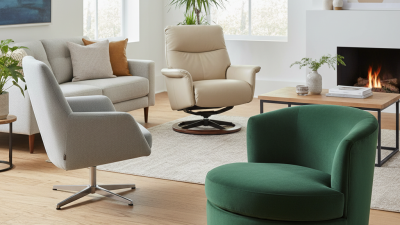
Lounge and accent chairs bring a softer shape, often with a broad cushion and a round rotating plate beneath the seat. Gaming chairs tend to emphasize recline, side support, and adjustable components, while salon and reception seating may prioritize wipe-clean surfaces and smooth rotation. Materials and mechanisms vary widely between factories, so the category name alone says little about durability. Ask about base construction, swivel testing, and replacement parts. Even then, specifications do not tell the whole story; a mechanism may feel stiff or develop play after repeated use.
What Chinese Brands and Manufacturers Are Known for Swivel Chairs?
China’s swivel-chair supply is better understood through manufacturing clusters than a single famous label. Anji, Zhejiang, has a dense chair-making ecosystem, while Guangdong factories often combine metalwork, upholstery, and export logistics. Buyers will encounter OEM and ODM producers, component specialists, and finished-chair factories. Their strengths differ. Some excel at compact task chairs with mesh backs and synchronized tilt; others make padded chairs with heavier bases. The distinction matters. The China National Furniture Association reported that above-scale furniture manufacturers generated about RMB 655.7 billion in revenue in 2023, down 4.4% year over year. This figure covers furniture broadly, not swivel chairs alone.
Demand offers another useful lens. Grand View Research estimated the global office-chair market at roughly US$13.1 billion in 2023, but this does not isolate Chinese-made swivel models. For sourcing, request test records for seat durability, tilt cycles, base stability, and gas-lift performance. Check whether armrests, casters, and replacement mechanisms remain available after the first shipment. Small details matter. A sample can look excellent yet wobble after repeated reclining. I would not rank manufacturers from online photos alone; factory audits and repeat-order consistency reveal more, though they cost time. Ask for specifications in writing, then compare a production sample against them.
Typical Seat-Height Ranges for Swivel Chairs
A product-category comparison—not a ranking of Chinese brands or manufacturers.
Ranges are approximate examples of commonly available seat-height adjustments. Actual dimensions vary by model; measure from the floor to the top of the seat.
How Do Leading Chinese Swivel Chairs Compare in Features and Use?
Chinese-made swivel chairs differ less by origin than by intended use, adjustment range, and component quality. A mesh task chair usually suits long desk sessions: breathable back fabric, seat-height adjustment, and a tilt lock help during warm afternoons and changing work postures. Executive-style chairs often add thicker foam and a wider seat, but bulk does not guarantee better support. Small details matter. Check whether the lumbar pad moves, whether the armrests adjust, and whether the casters roll smoothly on your actual floor.
Grand View Research estimated the global office chair market at USD 14.8 billion in 2023 and projected 5.3% annual growth from 2024 to 2030.
That market figure signals demand, not proof that every chair performs well. For comparison, look for clear load ratings, replacement-part availability, and test documentation aligned with recognized seating standards such as BIFMA X5.1. A conference-room swivel chair can prioritize easy rotation and a stable base; a home-office model needs finer fit adjustments. Sit in it, if possible. Ten minutes helps, but it will not reveal every pressure point. I would be cautious about judging comfort from product photos alone. The fit can be oddly personal.
What Should Buyers Check Before Choosing a Chinese Swivel Chair?
When comparing Chinese-made swivel chairs, check the evidence behind the specification sheet. The EU-OSHA OSH Pulse survey found that nearly three in five workers reported work-related musculoskeletal disorders. A chair cannot prevent every problem, but adjustable seat height, usable lumbar support, and a backrest that reclines smoothly can improve fit during long desk sessions. Small details matter. Sit in a sample chair for at least 15 minutes; notice pressure under your thighs and whether both feet rest flat.
Ask the supplier for an independent test report tied to the exact model, not a similar-looking range. Check the report’s test standard, rated user capacity, and results for stability, strength, and durability; ANSI/BIFMA X5.1 is a relevant office-chair test standard. Inspect the gas lift, tilt lock, armrest joints, and caster movement, then confirm replacement-part availability and warranty terms in writing. WHO recommends adults get 150–300 minutes of moderate-intensity activity each week, so a chair should support movement, not promise to replace it. This check is easy to skip. It is also where I would be more demanding: paperwork can look neat while a sample’s tilt mechanism feels loose.